Why 2026 Cybersecurity Starts With Vulnerability Management and Backups
July 9, 2026
Cybersecurity conversations often move quickly toward advanced tools, dashboards, and threat intelligence. Those tools matter, but many business risks still begin with two fundamentals: known vulnerabilities that remain exposed and backups that have not been tested under realistic recovery conditions.
In 2026, leaders should treat vulnerability management and backup recovery planning as operating disciplines. Attackers continue to look for weaknesses that are already known, misconfigured, or poorly governed. At the same time, ransomware and destructive incidents make recovery posture just as important as prevention.
A business can have security tools in place and still face unacceptable downtime if patching, prioritization, backup quality, and restore testing are inconsistent. Strong cybersecurity starts with knowing where exposure exists, deciding what needs attention first, and proving the organization can recover when systems are disrupted.
The gap is often ownership. Vulnerability scans may run without remediation follow-through. Patches may be delayed because no one has connected them to business risk. Backups may complete successfully while restores remain untested. Leaders may see activity without knowing whether risk is actually decreasing.
The practical issue is whether the organization has enough visibility, ownership, and operating discipline to manage technology risk before customers, employees, members, or regulators feel the consequences. Vulnerability management and backup recovery planning give leaders a clearer way to connect day-to-day IT work with continuity, compliance, and operational resilience.
Everyday systems often create the most visible exposure because they support the work people rely on most. Endpoints, servers, cloud applications, network devices, vendor access, and shared systems all need consistent attention. When those systems are poorly documented, inconsistently patched, or missing from backup planning, risk becomes harder to measure and harder to explain.
What Should Leaders Expect from Vulnerability Management?
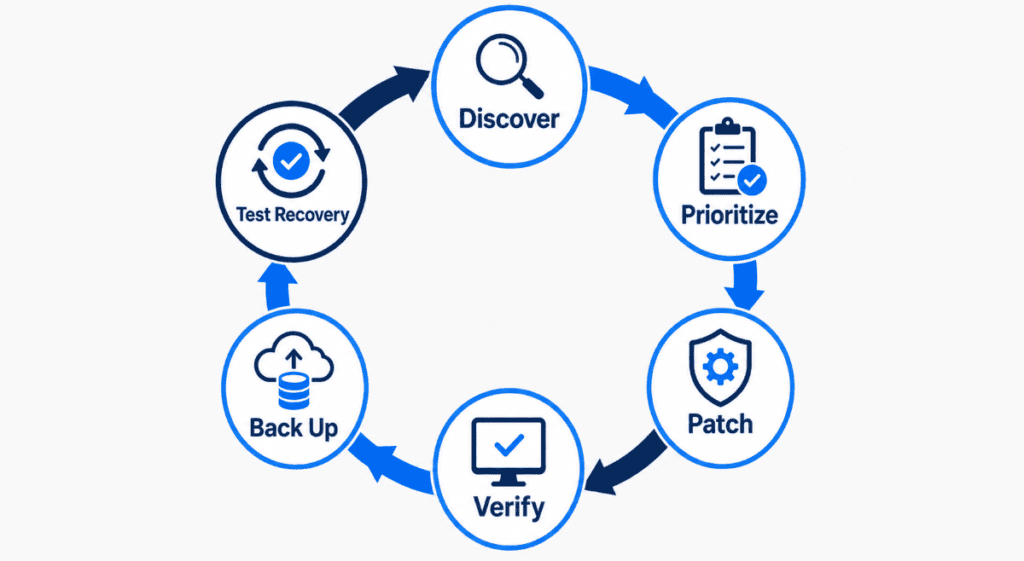
A mature vulnerability management process should identify exposed assets, prioritize findings by business impact, assign remediation owners, track exceptions, verify fixes, and report progress clearly. The goal is a repeatable rhythm that reduces the issues most likely to affect operations.
This is where vulnerability management becomes a leadership conversation. The right questions turn technical detail into decisions about risk tolerance, service continuity, budget timing, accountability, and the experience people expect from the organization.
A strong process should also produce a usable definition of success. For one organization, success may mean cleaner vendor access and better backup testing. For another, it may mean board-ready reporting, a documented compliance roadmap, or more support capacity for an internal team. Clear outcomes keep the work from becoming a collection of disconnected technical tasks.
Practical Controls Turn Risk Into an Operating Discipline
The strongest programs are rarely built from a single large initiative. They improve through a steady sequence of controls that are documented, reviewed, and adjusted as the organization changes. Leaders should look for progress that can be explained clearly and repeated consistently.
Priority actions include:
Maintain current asset visibility across endpoints, servers, cloud environments, and network devices
Prioritize remediation based on exploitability and business impact
Patch systems through defined maintenance windows
Test backup restoration, not only backup completion
Document exceptions, owners, and timelines
Report trends to leadership in plain language
These controls help organizations move from reactive cleanup to proactive risk management. They also make it easier to explain which risks have been reduced, which risks remain, and where a leadership decision is needed.
Backups should be treated as a business continuity control, not a background task. Leaders need to understand recovery time objectives, recovery point objectives, system dependencies, retention policies, and the results of restore tests.
That visibility helps organizations make better decisions before a stressful incident. If a key system goes down, the question is rarely whether a backup exists. The real question is whether the organization can restore the right data, in the right order, within a timeframe the business can tolerate.
Backup recovery planning should also account for dependencies. A restored application may still need identity access, network connectivity, endpoint availability, vendor coordination, or clean data from another system. Testing helps uncover those issues before they become expensive surprises.
A practical roadmap should separate urgent risk reduction from longer-range modernization. Quick wins often include account cleanup, multifactor authentication enforcement, backup validation, vendor access review, patch prioritization, documentation, and clearer escalation paths.
Larger improvements may require budget planning, downtime windows, equipment replacement, policy updates, or cross-department coordination. Sequencing matters because organizations rarely have unlimited time, staff, or budget. A phased plan helps leaders make visible progress without overwhelming teams.
It also gives managers a better way to explain why one improvement comes first, why another should wait for a planned window, and how each step supports security, productivity, compliance, or continuity.
Clear Reporting Keeps Cybersecurity Aligned With Business Priorities
Leadership visibility makes the roadmap more useful. Reporting should connect technical work to business outcomes: fewer interruptions, better recovery options, stronger compliance evidence, clearer vendor accountability, and more predictable planning.
Useful reporting explains what changed, what remains open, what risk has been reduced, and where a decision is needed. It should be plain enough for nontechnical leaders and detailed enough for IT or operations teams to act.
This cadence keeps technology aligned with business priorities instead of leaving important decisions buried in tickets, email threads, or vendor portals.
Security-First Planning Protects Growth and Continuity
Technology strategy should feel practical enough to use. The best plans identify near-term improvements, assign owners, document dependencies, and create a review cadence that can hold up during busy seasons, leadership changes, vendor renewals, and new business requirements.
A security-first plan also creates better conversations with vendors, insurers, auditors, boards, and internal teams. It shows that the organization understands its environment and is actively improving the controls that protect people, data, operations, and reputation.
Pearl Solutions Group helps organizations strengthen cybersecurity and IT operations through proactive protection, vulnerability management, patching, data backup and recovery, monitoring, and clear reporting. Strong fundamentals give businesses a better foundation for advanced protection, practical resilience, and dependable continuity.
Spencer Hoppes helped me with a password issue. I had submitted the request 2 weeks prior and no response. the email was sent to the wrong email address (my error). Once Spencer was assigned my ticket, within minutes he was on the phone with me. My issue was resolved quickly. He was so helpful and made sure I had no other issues before we disconnected the call. People like Spencer make technical issues not so bad!
Read Moreread less
B. Henton
3/02/2026
Answered all my Random questions and remedied my issues!!!Thank you
Read Moreread less
D. Fisher
3/02/2026
Seth found and fixed my issue immediately. The response time and resolution time was excellent!!
Read Moreread less
D. Schroeder
2/27/2026
Adam is the model of customer service in I.T. today! He listened, understood with limited knowledge. He quickly troubleshooted and resolved a half a day issue! KEEP HIM!
Read Moreread less
P. Department
2/26/2026
I work for a company that uses their system, and they have never failed us! From the astonishing customer service to the quick responses, highly recommend them to anyone!
Read Moreread less
c. morrison
2/20/2026
Pearl is such a pleasure to work with! They understand the problem and help resolve it in an expedient and professional manner that gets me up and running quickly!
Read Moreread less
R. Morales
2/12/2026
Brendan and Luke were great to work with while starting my new job. They helped me resolve my IT issues quickly and made what could have been a stressful process feel easy. Both of them were kind, professional, and kept me informed. I really appreciated how responsive and communicative they were, and they didn’t stop until everything was fully resolved. Great support and a great first impression. Thank you both!
Read Moreread less
C. Friend
2/06/2026
Adam was great. Please give him all the money!
Read Moreread less
J. Robbins
1/29/2026
Very helpful group! We appreciate you all.
Read Moreread less
A. Owens
1/09/2026
Matt also does a great job of being professional, and patient as we navigated the issues - I appreciate the patience and dedication to the tasks at hand!
Read Moreread less
J. Anna
12/19/2025
Adam was very knowledgeable, professional, and kind. He was able to quickly resolve my problem.
Read Moreread less
J. Kempker
12/11/2025
Using Pearl for IT onboarding support at my new job. Seth and Chance were a huge help, fast and friendly in resolving my issues! Good stuff!
Read Moreread less
S. Coffey
11/21/2025
Chance was the best! "Super-fast response and resolution to my issue. Thanks."
Read Moreread less
J. Henry
11/12/2025
Very good and prompt service!
Read Moreread less
D. Faulkner
11/04/2025
Luke was great. Fixed me up in no time. Thanks Luke
Read Moreread less
R. Borden
11/04/2025
Nicholas Lembeck did a document search for us in old unavailable documents and found what we needed. It saved a huge amount of work and headache and will help us with the regulatory agencies
Read Moreread less
T. Thomas
10/17/2025
Courteous company and back up and running in no time.
Read Moreread less
R. Voissement
10/13/2025
Adam was an absolute Saint! Thorough, detail oriented, and downright pleasant. I'm very thankful that our IT team isn't a team I will dread contacting and i may even get some laughs along the way to problem resolution.
Read Moreread less
K. Donaldson
9/26/2025
Branding a great job of fixing the issue.
Read Moreread less
D. Jackson
9/24/2025
I needed help setting up the accounting email to my outlook account and Nicholas Lembeck helped me. It was done perfectly and quickly. He then let me know about it being fixed.
Read Moreread less
P. Duckworth
9/22/2025
Luke crushed it today troubleshooting a few items on my end. I have also had 5 star experiences with Matt and Brian. Great team over at Pearl!
Read Moreread less
T. Bohnert
9/19/2025
Brandi did an amazing job catching a phishing email that i thought was legit.
Read Moreread less
G. Bowers
9/15/2025
Nicholas, along with all of the other representatives from Pearl, are fantastic. They consistently work issues all the way to resolution with nothing left partially complete.
Read Moreread less
J. Ward
9/09/2025
Nick was attentive, professional and very prompt! He provided excellent customer service.
Read Moreread less
s. davis
9/08/2025
Great experience working with Pearl - extremely helpful and professional!
Read Moreread less
J. Salinas
9/04/2025
Always have a great experience with the team in getting my tech issues resolved quickly!
Read Moreread less
J. Augustine
9/02/2025
Adam did a tremendous job with our team. Kind, courteous, and patient, Pearl has continued to provide excellent service over our company's tenancy.
Read Moreread less
A. Reinhardt
8/29/2025
I had a great experience working with Nicholas on an issue I had. He was quick to respond and had a solution right away. My company uses Peal and they are always patient and eager to help!
Read Moreread less
I. Sassen
8/26/2025
I called in with the issue, it was solved and explained to me for the future All done in minutes What more could you ask for
Read Moreread less
B.
8/20/2025
Great service, responsive. Explained the reason why the email could not be released. Protected my email from a hacker. Happy with the servie.
Read Moreread less
C. Janean
8/12/2025
Nicholas L. was great, took initiative, investigated and solved my issue quickly.
Read Moreread less
L.
8/06/2025
My Company uses Pearl and has for years now! The service is always good and staff is always helpful. Today Seth Pruitt went above and beyond to help me out with software issues. Not only did he correct my work issues, but took the time to help with personal issues that were also impacting my programs and emails. Thank you so much for all your help! You made my day!!
Read Moreread less
A. Frisella
8/05/2025
Nicholas was very helpful and knowledgeable. Excellent people skill.
Read Moreread less
H. Nguyen
7/31/2025
Fast, expert, and thorough problem resolution!
Read Moreread less
A. Faiello
7/25/2025
Ethan was very friendly, efficient, and helpful throughout.
Read Moreread less
K. Frazier
7/24/2025
Very dependable and reliable. Fast but great service with 100% satisfaction. I highly recommend Pearl Solutions for my protection.
Read Moreread less
B. Hollamon
7/24/2025
I have been using Pearl for several years. Their service has always been exceptional. My experience yesterday with Adam was a perfect example. He responded quickly discover the problem and fixed the issue. Thank you Pearl for your world class service.
Read Moreread less
D. sabada
7/24/2025
Expertise is just one phone call away!
Read Moreread less
M. Hillin
7/23/2025
It's always good to give credit where credit is due. Ethan saved SharePoint one day after I broke it. I was beyond concerned with a mistake I made. I put in a ticket, and he called me less than 30 minutes after. It was a relief to know that the problem was fixed before anyone realized there was a problem. I would also like to recognize Nick, the unsung hero who is always here and ready to lend a hand. He stopped what he was doing to help me get set up after I came on board. I couldn't have done it without him.
Read Moreread less
J. Thompson
7/23/2025
Adam was so helpful and patient with me while fixing an issue with my authenticator/email on my new phone. I appreciate his help and willingness to walk through all the steps with me as many times as necessary to get my email in working order! GREAT JOB!
Read Moreread less
C. Hageman
7/21/2025
Extremely helpful and they have a very fast response time. Would highly recommend to anyone looking for a dedicated and efficient team.
Read Moreread less
Z. Brown
4/02/2025
quick response time resolved the issue kind
Read Moreread less
j. Hodge
3/26/2025
I had the pleasure of working with Pearl Solutions Group, and I couldn't be more impressed with their service! From start to finish, their team provided outstanding customer support. They were incredibly responsive, always answering my questions and addressing any concerns in a timely manner. The attention to detail and willingness to go above and beyond made my experience seamless. The entire team was not only professional but also genuinely helpful, ensuring I received the best solutions for my needs. If you're looking for a reliable and customer-focused team, I highly recommend Pearl Solutions Group!
Read Moreread less
K. Cline
3/19/2025
Willis was wonderful to work with.
Read Moreread less
T. Bolden
3/19/2025
Always timely in their response and respond with the technical skill to fix my problem. The last was a VPN connection issue that Willis, though he didn't have the answer at hand, put me on hold and sought out help internally. He returned and quickly identified and resolved the issue.
Read Moreread less
K. Thompson
3/02/2025
Pearl is always fast to respond, understands my workload, and gets me up and running in no time. Friendly, courteous, effective.
Read Moreread less
T. Pletcher
3/02/2025
Service tech was courteous and very helpful. Definitely streamlined the process
Read Moreread less
J. Noto
3/02/2025
I don't have to open tickets very often. But in the past year when I do open a ticket, it is resolved in a VERY timely manner and the first time! Willis did a great job!
Read Moreread less
C. Gary
3/02/2025
I had a small issue with a file and I was not actually not working but needed it fixed before Monday am. Seth kept in communication with me throughout the day until I was back at my computer to allow him to login. He had the issue fixed in less than 5 minutes. His patience with me and his knowledge of the issue made this much easier. Everytime I work with Seth I have wonderful experience.
Read Moreread less
C. Air
3/02/2025
Excellent customer service
Read Moreread less
C. Corey
3/02/2025
Issue was addressed and solved very quickly and professionally.
Read Moreread less
A. Sevier
3/02/2025
Pearl Technicians can always be counted on for great service and are very knowledge. THX ETHAN!!!
Read Moreread less
M. Stringer
2/02/2025
Had a great experience with your Tech, Willis. He was very polite and got me up and going in no time. Thank you.
Read Moreread less
t. holderman
2/02/2025
I love working with Pearl Solutions Group! They take care of all of our computer networks for us and help us get through issues very quickly! I highly recommend them!
Read Moreread less
A. Riley
2/02/2025
Always responsive and first call resolution.
Read Moreread less
A. Slinkard
2/02/2025
These gentlemen were patient with me, understood my needs, followed through with their assurances and succeeded in meeting my various needs. They provided excellent customer service at each opportunity!! Despite how stressed I was, these guys fixed problems I was having AND put a smile on my face!! Thanks from Ree!!
Read Moreread less
M. Batchen
1/02/2025
Brandi gave me a quick response this morning and was on top of the problem! I appreciate her kindness and ability to get me back on track with my work! I've always had quick responses and professional interactions anytime I've reached out to Pearl for support! They have a great team!
Read Moreread less
A. Rye
1/02/2025
Always a great experience!
Read Moreread less
A. Albaugh
1/02/2025
I received a new laptop at work and needed help getting access to my OneNote files. Michael Morrisey went out of his way to help me and saved me from recreating MANY files! Great customer service!
Read Moreread less
D. McGuire
1/02/2025
Pearl Solutions Group is the BEST! Thank you for your tremendous service and attention.
Read Moreread less
S. St.
1/02/2025
I recently worked with Seth Pruitt to get my VPN connection and access to my companies remote servers back up after having to wipe a MacBook Pro. Seth was professional and explanitory every step of the way. I highly recommend if you have the option, ask for Seth to help you with your IT needs.
Read Moreread less
R. Lister
1/02/2025
Jacob was great to work with and super responsive to my calls and requests needed to set up two new employees computers.
Read Moreread less
K. Krueger
12/02/2024
I work with pearl with my company and they are always very nice and helpful! I’ve gone through iPad fixes to simple email fixes and they are also extremely thorough and easy to contact
Read Moreread less
A. Delannoy
12/02/2024
I was able to work with Brendan on a couple service tickets and the level of help, support and professionalism was top notch! Super smooth experience.
Read Moreread less
K. Miller
12/02/2024
Chance did an amazing job with quick support to help get our devices up & running! Very impressed with your team.
Read Moreread less
C. Davis
12/02/2024
Helpful and friendly
Read Moreread less
G. Marshall
12/02/2024
Ethan and Pearl Solutions were wonderful in helping my advertising agency transition into our new office. From minor inconveniences to entire device transfers, the team was helpful every step of the way. Would highly recommend to anyone in need of technical support!